Classtools is a fabulous site, with great resources to use with students.
These are the steps my class and I went through when dealing with diary writing.
1) Choosing a fictional, historical, cartoon or legendary character.
2) Creating Fakebook profiles and writing diary entries.
Some of them didn't use the web tool and drew their own profiles on paper.
Here are some samples from students' works.
Click here to view fullscreen.
Click here to view fullscreen
3) Editing the writing and getting feedback from the teacher
4) Printing the profiles
5) "Visiting" each other's profiles and commenting on them using post-it notes.
Students, in their character's shoes, could leave a public message on the wall, that everyone could read and comment, or write a private "message" ( a folded post-it ) that only the owner of the profile could open and read.
This activity, which took us 3 class hours , let the students have a lot of practice at asking questions, reading and writing. And I especially liked the fact that both technology and paper proved to be effective tools and worked together to reach the teaching aim.
"You talk as if a god had made the Machine.. Men made it, do not forget that. Great men, but men. The Machine is much, but it is not everything. I see something like you in this plate, but I do not see you. I hear something like you through this telephone, but I do not hear you. That is why I want you to come. Pay me a visit, so that we can meet face to face, and talk about the hopes that are in my mind."The machine stops - 1909 - Forster
Showing posts with label english teaching. Show all posts
Tuesday, January 24, 2012
Friday, December 9, 2011
The semi-flipped classroom: an experiment
What does "flipping the classroom" mean?
Basically it is a teaching method where students have to watch videos for homework while traditional home work is done in class with the teacher supervision.
What I did with my class
I wanted to give it a try. Keeping in mind that the best thing is always to take a "baby step" and start with a small change, this is what I did in a second class of Middle School.
We'd been dealing with present simple tense for some weeks and time had come to move on to the present continuous. The common procedure would have been:
P presentation
P practice
P production
P personalization
But this time we didn't start with the presentation phase.
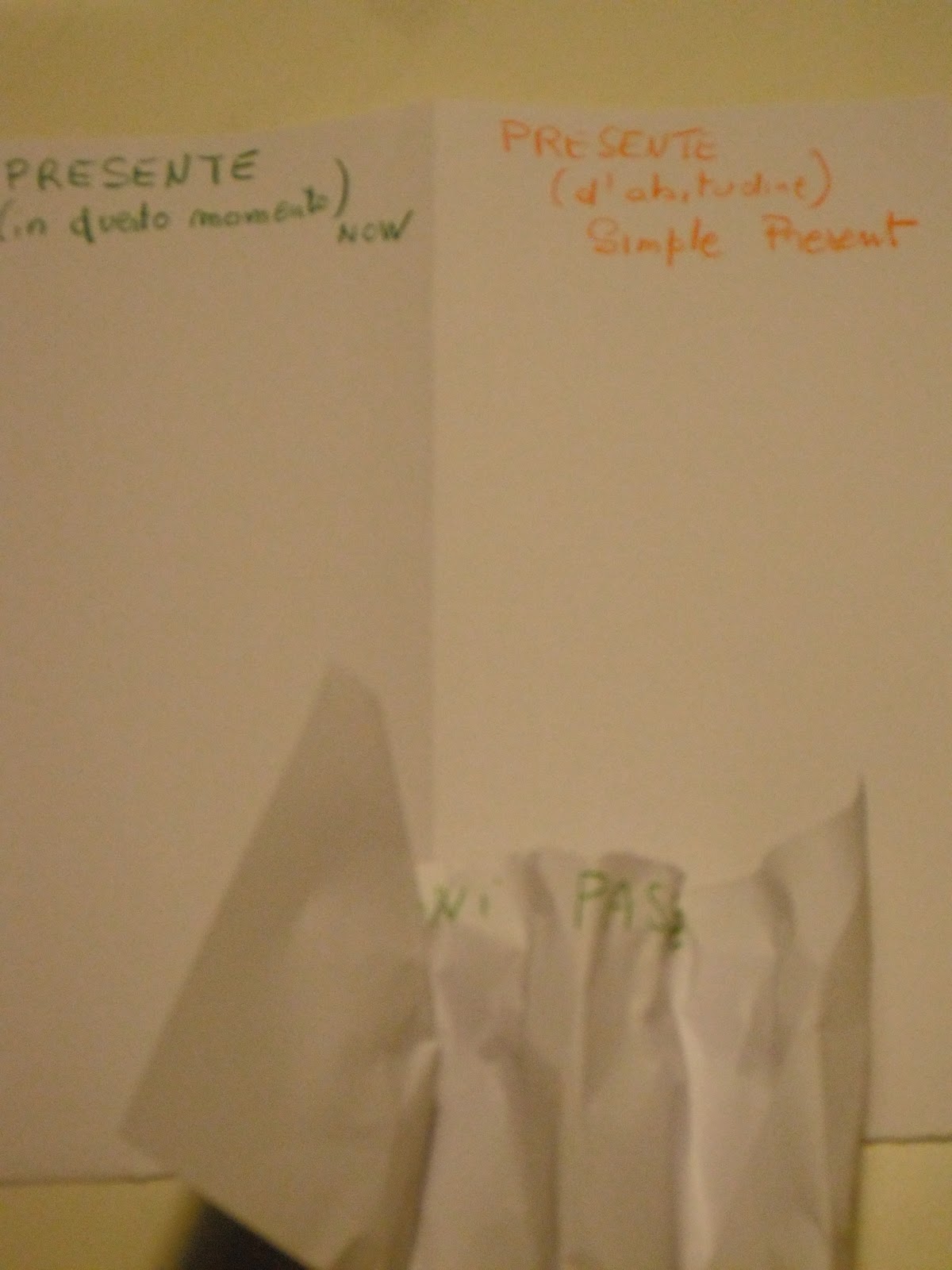
In class I dictated some sentences in Italian ( their mother tongue ) to the students, who had previously divided a piece of paper into three sections, like this:
They wrote the sentences, in Italian, in the correct section, dividing them into now-actions, habits and past actions.
First thing after doing that, they ripped out the "past actions" part of their paper and they threw it away.
My intention was to make them physically aware of the fact we were dealing with present actions ( yes, maybe it's hard to believe and a bit disappointing, but some of them still had problems in fully grasping the concept of present/past actions ).
Then, as a class activity, we translated the "simple present" sentences into English and that was a revision of our last grammar topic. At this point they were left with some sentences they couldn't translate by applying what they knew. I told them they had to use a new grammar structure but I also declared I wasn't going to tell them anything about it, in other words: I wasn't going to "explain" it to them.
In short, this is what I said:
" Ok, let's see if you can do it by yourself. Go and watch this glogtster. There are some short videos explaining how to use the present continuous. Watch them carefully, as many times as you like, and, when you think you have figured it out, write the "rule" of this new tense on a piece of paper and put it in an envelope. Seal it, write your name on it and hand it in next lesson. I'm going to give you a "plus point" if you do it correctly."
NB
* "plus" and "minus" points are part of our classroom management, a sort of "token economy" approach. Students get plus and/or minus points, which are an integral part of their assessment.
* the envelope had the purpose to charge the activity with a sort of "formality", an official character, to make it appear important to the students' eyes.
I have to say that this task was optional, because not all the students have internet access at home. That's one of the reasons why I called it "the SEMI-flipped" class experiment.
This is the present continuous glogster I had previously done and published online.
The following lesson, 12 students out of 21 had done what I had asked them to do.
Nearly all of them had been able to understand how to form a sentence using the present continuous, as you can see from the pictures.
| Slideshow design made with Smilebox |
First reflections
I was obviously happy about the result especially because the 12 students were not just the best ones.
First thought was: " You see?! They don't even need a teacher..at least, not a teacher in the traditional way..."
and my second reflection was on how to "exploit" those savvy students for the whole class benefit.
So I gave my usual presentation on the topic to the class ( using IWB and Power Point and more ) and in the practice phase we worked in groups. In each group there was at least one present continuous-self-trained student. I got the impression that in the group work there was more energy and enthusiasm than there had been in other occasions.
A lot of practice lessons structured in this way gave them the opportunity to learn and consolidate the grammar point according to their learning styles. One of their final outcomes was the creation of a mindmap, where the main focus was on the two visual reminders ( the bee and the boeing ).
Click here to see another example of mindmap.
Results
Of course, at this point, I'm not able to draw conclusions on the students' ability to retain the information in the long-term memory, neither can I say this was the best way to introduce the topic, but I can share the results of the class test. Far from being the most effective way to assess students' learning, grammar tests are nevertheless quite clear indicators of the students' progression in the initial stages of Bloom taxonomy, that is they show how well a rule, a structure has been remembered and understood.
And the test results were amazing!
The class average test score was 8,4 out of ten, which is definitely high if we consider that middle school classes in Italy are strongly mixed-ability.
Conclusions
I called this experiment "the semi-flipped" classroom for two main reasons:
1) not the whole class watched the videos at home
2) the "explanation" phase was double and not only confined to something to be done at home, but it was used as a sort of reinforcement for some students and as check/verification for others.
It was certainly rewarding and I'd like to consider it a small step on a long path worth walking on.
This is a great infographic to visualize the concept of "flipped classroom"
Created by Knewton and Column Five Media
Friday, August 26, 2011
WEB2 COURSE: presentation
Here you can find the course overview.
Example 2
Example 3
Web2 course
Example 1 View more presentations from Daniela Tomatis
This is last course introductory speech ;)

If you want to have a look at what was created by students who took the course last spring, click on the links below.
This is last course introductory speech ;)
If you want to have a look at what was created by students who took the course last spring, click on the links below.
Example 2
Example 3
Saturday, October 30, 2010
SYLLABUS BLACKBOARD VS. UNPLUGGED BLACKBOARD
This post is a response to Jason Renshaw's initiative "Meeting of the boards".
I really liked the idea of starting a lesson having students fill up the blackboard and so I tried it in two classes of same level, that is third year of Middle School ( lower A2 ). But I did it in a slightly different way.
In the first class I drew a line which divided the blackboard diagonally in two parts: at one end I wrote "September 13th" ( the first day of school ) and at the other end I wrote "Today".

The line might have worked as a sort of reminder of school time because they started writing headings related to topics we had been covering since the beginning of the term.

They went on this neutral path until a student wrote something more personal
( emoticons / sad-smiling day ).

At this point, quite interestingly, another student came up with a sort of "brainwave" and she wrote what you can see in the cloud.

This is the final risult: the blackboard is full of words related to activities, grammar and vocabulary covered in class in the previous months. Let's call it the Syllabus Blackboard.

With the other class the blackboard was completely empty: no words, no lines at all. At the beginning the students were quite surprised but after a few seconds one came to the blackboard and wrote "Hello": simple and safe...:)
They went on asking basic questions until a student wrote a sentence ( a question again ) taken from "Alice in Wonderland - A Mad Tea Party", a role play we had acted out the previous year.

After that they started "reflecting" on the whole process, and they asked two more questions, as if they really wanted to get answers and explanations.

Next a student provided his personal solution: "We are as mad as a hatter".

At this point a student gave some feedback and, using SMS English, he wrote "I like dizz"

And this is the final result : a blackboard full of questions, a creative and personal board, I would say. A student even modified " I like dizz" into "I like pizza".

CONCLUSIONS
* I enjoyed the activity and so did the students
* A line with dates seems to be a powerful way to direct students' attention to their linear learning progression
* A blank blackboard can appeal to students' need to communicate in a non-threatening, free, and light-hearted way and can help them express themselves creatively.
Really liked this idea of meeting of the boards!! :).Thank you!!
I really liked the idea of starting a lesson having students fill up the blackboard and so I tried it in two classes of same level, that is third year of Middle School ( lower A2 ). But I did it in a slightly different way.
In the first class I drew a line which divided the blackboard diagonally in two parts: at one end I wrote "September 13th" ( the first day of school ) and at the other end I wrote "Today".

The line might have worked as a sort of reminder of school time because they started writing headings related to topics we had been covering since the beginning of the term.

They went on this neutral path until a student wrote something more personal
( emoticons / sad-smiling day ).

At this point, quite interestingly, another student came up with a sort of "brainwave" and she wrote what you can see in the cloud.

This is the final risult: the blackboard is full of words related to activities, grammar and vocabulary covered in class in the previous months. Let's call it the Syllabus Blackboard.

With the other class the blackboard was completely empty: no words, no lines at all. At the beginning the students were quite surprised but after a few seconds one came to the blackboard and wrote "Hello": simple and safe...:)

They went on asking basic questions until a student wrote a sentence ( a question again ) taken from "Alice in Wonderland - A Mad Tea Party", a role play we had acted out the previous year.

After that they started "reflecting" on the whole process, and they asked two more questions, as if they really wanted to get answers and explanations.

Next a student provided his personal solution: "We are as mad as a hatter".

At this point a student gave some feedback and, using SMS English, he wrote "I like dizz"

And this is the final result : a blackboard full of questions, a creative and personal board, I would say. A student even modified " I like dizz" into "I like pizza".

CONCLUSIONS
* I enjoyed the activity and so did the students
* A line with dates seems to be a powerful way to direct students' attention to their linear learning progression
* A blank blackboard can appeal to students' need to communicate in a non-threatening, free, and light-hearted way and can help them express themselves creatively.
Really liked this idea of meeting of the boards!! :).Thank you!!
Subscribe to:
Posts (Atom)