After exploring the mindmap "My favourite web2 tools" you can post your reflections, questions, requests, doubts on this online board
Dopo aver esplorato la mappa " My favourite web2 tools", potete usare questa lavagna online per fare domande, avanzare richieste e condividere riflessioni.
Monday, May 7, 2012

Sunday, May 6, 2012
Saturday, April 21, 2012
INTEGRATING TECHNOLOGY: "Create your own path"- mixed ability classes
The main problem in a mixed ability class is that it is quite difficult to give each student what he needs and you get the feeling that nobody is working at his own pace.
This is a profile of a mixed-ability class, as it is perceived by the students themselves.
Mixed-ability class: a quick survey on PhotoPeach
The project "Create your own path" has two main objectives:
- to provide students with a wide variety of activities
- to give them the possibility of being assessed in an alternative way.
Here you can watch the presentation of the project.
Mixed-ability class: a quick survey on PhotoPeach
The project "Create your own path" has two main objectives:
- to provide students with a wide variety of activities
- to give them the possibility of being assessed in an alternative way.
Here you can watch the presentation of the project.
Sunday, March 11, 2012
KET VOCABULARY : glogster
A big thank you to Cristina ( III E ) and Martino ( III A ) who created e-flashcards and greatly contributed to the realisation of this Glogster. It may come in handy for those who are studying for KET exam.
Click here to open full size.
Click here to open full size.

Saturday, February 11, 2012
Tuesday, January 24, 2012
INTEGRATING TECHNOLOGY: diary writing and paper blogging
Classtools is a fabulous site, with great resources to use with students.
These are the steps my class and I went through when dealing with diary writing.
1) Choosing a fictional, historical, cartoon or legendary character.
2) Creating Fakebook profiles and writing diary entries.
Some of them didn't use the web tool and drew their own profiles on paper.
Here are some samples from students' works.

Click here to view fullscreen.

Click here to view fullscreen
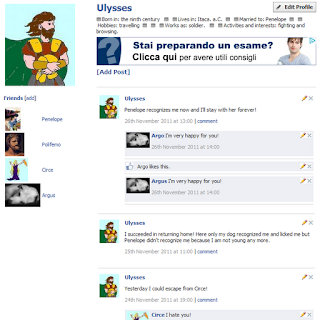
Click here to view fullscreen
3) Editing the writing and getting feedback from the teacher
4) Printing the profiles
5) "Visiting" each other's profiles and commenting on them using post-it notes.
Students, in their character's shoes, could leave a public message on the wall, that everyone could read and comment, or write a private "message" ( a folded post-it ) that only the owner of the profile could open and read.


This activity, which took us 3 class hours , let the students have a lot of practice at asking questions, reading and writing. And I especially liked the fact that both technology and paper proved to be effective tools and worked together to reach the teaching aim.
These are the steps my class and I went through when dealing with diary writing.
1) Choosing a fictional, historical, cartoon or legendary character.
2) Creating Fakebook profiles and writing diary entries.
Some of them didn't use the web tool and drew their own profiles on paper.
Here are some samples from students' works.

Click here to view fullscreen.

Click here to view fullscreen

Click here to view fullscreen
3) Editing the writing and getting feedback from the teacher
4) Printing the profiles
5) "Visiting" each other's profiles and commenting on them using post-it notes.
Students, in their character's shoes, could leave a public message on the wall, that everyone could read and comment, or write a private "message" ( a folded post-it ) that only the owner of the profile could open and read.


This activity, which took us 3 class hours , let the students have a lot of practice at asking questions, reading and writing. And I especially liked the fact that both technology and paper proved to be effective tools and worked together to reach the teaching aim.
Monday, January 23, 2012
INTEGRATING TECHNOLOGY: vocabulary expansion
What follows is a way to help students expand their vocabulary.
Especially at elementary level they tend to overuse the same basic words and their essays are quite repetitive.
Last week my class ( third year middle school ) was given a written test : " My trip to England", as a closing activity after a civilization unit about the United Kingdom.
While checking their essays I noticed their writings were full of words such as "go", "beautiful", "place" and "see".
I wanted to make them visually aware of this and so I asked them to recopy their texts using the computer, to save the file, to copy the document and to paste it into Wordle.
These are some of the word clouds they created.


 At school, the following lesson, the students examined each other's clouds and commented on them.
So we decided to work on the BIG words, the ones which recurred more often in their writings, and to find synonyms.
On the IWB we used a free visual Thesaurus .


Especially at elementary level they tend to overuse the same basic words and their essays are quite repetitive.
Last week my class ( third year middle school ) was given a written test : " My trip to England", as a closing activity after a civilization unit about the United Kingdom.
While checking their essays I noticed their writings were full of words such as "go", "beautiful", "place" and "see".
I wanted to make them visually aware of this and so I asked them to recopy their texts using the computer, to save the file, to copy the document and to paste it into Wordle.
These are some of the word clouds they created.


So we decided to work on the BIG words, the ones which recurred more often in their writings, and to find synonyms.
On the IWB we used a free visual Thesaurus .


We also used a great tool to work with collocations, Just the word.


The students updated their lexical notebooks with all the new nouns, verbs and adjectives.
I told them that, at this point, they had to take their essays and try to make them better,by adding and substituting words in the texts whenever possible.
One of them had a brilliant idea and proposed: " What if we do the same wordle thing again? After the redrafting, in the clouds there shouldn't be any big words. We should end up with a plain text!"
They liked the solution and, the following lesson, they were proud of their new wordle clouds.
Here are two of them.
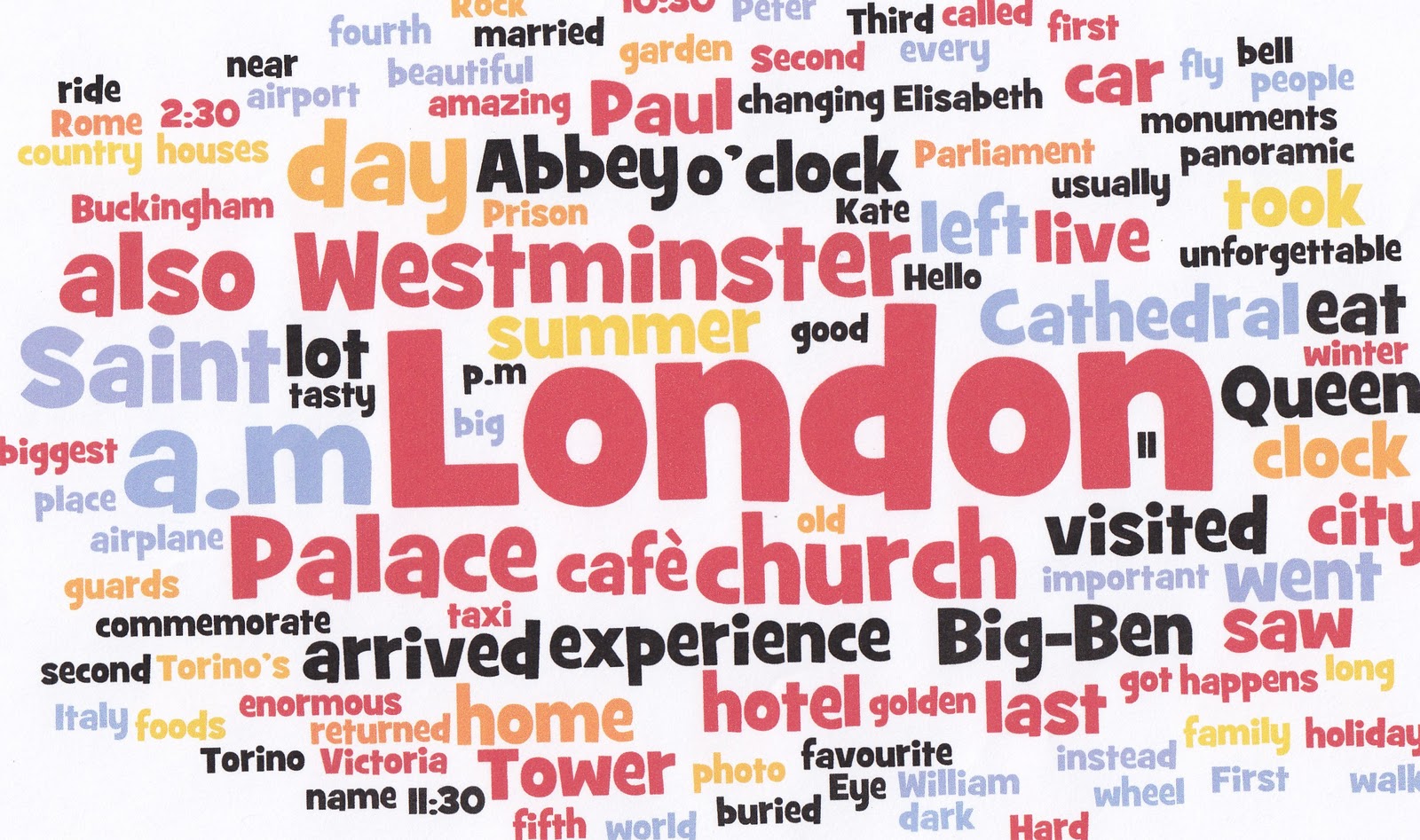
For more ideas on how to use Wordle in the classroom have a look at this presentation by David Dodgson.
You can also find interesting ideas here.
************************
PS What if I put this post into Wordle?

Whoops! Too many "words clouds" and "students"!
Subscribe to:
Posts (Atom)