Saturday, February 11, 2012

Tuesday, January 24, 2012
INTEGRATING TECHNOLOGY: diary writing and paper blogging
Classtools is a fabulous site, with great resources to use with students.
These are the steps my class and I went through when dealing with diary writing.
1) Choosing a fictional, historical, cartoon or legendary character.
2) Creating Fakebook profiles and writing diary entries.
Some of them didn't use the web tool and drew their own profiles on paper.
Here are some samples from students' works.

Click here to view fullscreen.

Click here to view fullscreen
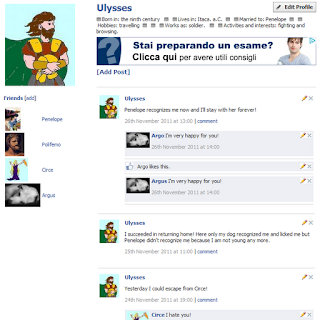
Click here to view fullscreen
3) Editing the writing and getting feedback from the teacher
4) Printing the profiles
5) "Visiting" each other's profiles and commenting on them using post-it notes.
Students, in their character's shoes, could leave a public message on the wall, that everyone could read and comment, or write a private "message" ( a folded post-it ) that only the owner of the profile could open and read.


This activity, which took us 3 class hours , let the students have a lot of practice at asking questions, reading and writing. And I especially liked the fact that both technology and paper proved to be effective tools and worked together to reach the teaching aim.
These are the steps my class and I went through when dealing with diary writing.
1) Choosing a fictional, historical, cartoon or legendary character.
2) Creating Fakebook profiles and writing diary entries.
Some of them didn't use the web tool and drew their own profiles on paper.
Here are some samples from students' works.

Click here to view fullscreen.

Click here to view fullscreen

Click here to view fullscreen
3) Editing the writing and getting feedback from the teacher
4) Printing the profiles
5) "Visiting" each other's profiles and commenting on them using post-it notes.
Students, in their character's shoes, could leave a public message on the wall, that everyone could read and comment, or write a private "message" ( a folded post-it ) that only the owner of the profile could open and read.


This activity, which took us 3 class hours , let the students have a lot of practice at asking questions, reading and writing. And I especially liked the fact that both technology and paper proved to be effective tools and worked together to reach the teaching aim.
Monday, January 23, 2012
INTEGRATING TECHNOLOGY: vocabulary expansion
What follows is a way to help students expand their vocabulary.
Especially at elementary level they tend to overuse the same basic words and their essays are quite repetitive.
Last week my class ( third year middle school ) was given a written test : " My trip to England", as a closing activity after a civilization unit about the United Kingdom.
While checking their essays I noticed their writings were full of words such as "go", "beautiful", "place" and "see".
I wanted to make them visually aware of this and so I asked them to recopy their texts using the computer, to save the file, to copy the document and to paste it into Wordle.
These are some of the word clouds they created.


 At school, the following lesson, the students examined each other's clouds and commented on them.
So we decided to work on the BIG words, the ones which recurred more often in their writings, and to find synonyms.
On the IWB we used a free visual Thesaurus .


Especially at elementary level they tend to overuse the same basic words and their essays are quite repetitive.
Last week my class ( third year middle school ) was given a written test : " My trip to England", as a closing activity after a civilization unit about the United Kingdom.
While checking their essays I noticed their writings were full of words such as "go", "beautiful", "place" and "see".
I wanted to make them visually aware of this and so I asked them to recopy their texts using the computer, to save the file, to copy the document and to paste it into Wordle.
These are some of the word clouds they created.


So we decided to work on the BIG words, the ones which recurred more often in their writings, and to find synonyms.
On the IWB we used a free visual Thesaurus .


We also used a great tool to work with collocations, Just the word.


The students updated their lexical notebooks with all the new nouns, verbs and adjectives.
I told them that, at this point, they had to take their essays and try to make them better,by adding and substituting words in the texts whenever possible.
One of them had a brilliant idea and proposed: " What if we do the same wordle thing again? After the redrafting, in the clouds there shouldn't be any big words. We should end up with a plain text!"
They liked the solution and, the following lesson, they were proud of their new wordle clouds.
Here are two of them.
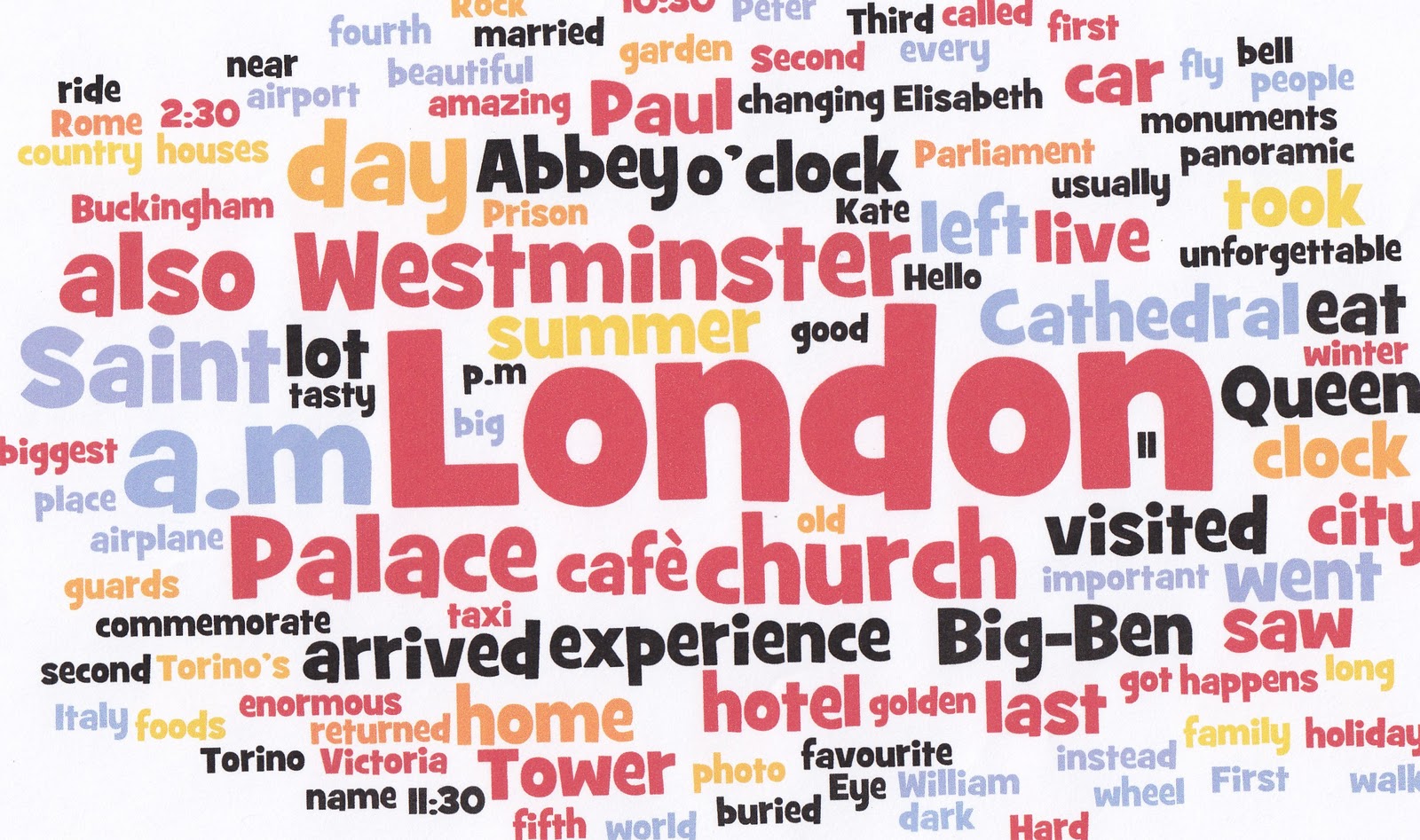
For more ideas on how to use Wordle in the classroom have a look at this presentation by David Dodgson.
You can also find interesting ideas here.
************************
PS What if I put this post into Wordle?

Whoops! Too many "words clouds" and "students"!
Thursday, January 19, 2012
How to make students "digest" the Past Simple

PAST SIMPLE : AN EASY RECIPE
Ingredients

- from 20 to 25 students beginner level ( possibly aged 12-13 )
- at least 100 biscuits decorated with chocolate ED
- a blackboard or IWB
45 minutes
Instructions
Tell students you have both GOOD news ans bad news.
Ask them what they want to start with ( for a better result make them choose the first option ).
Elicit verbs in the infinitive. Write just the GOOD ones on bb ( if they say "eat", "sleep", "go"...make a sad face and say "sorry, that is bad news" ). When you have a lot of them displayed on the blackboard, tell them to close their eyes.
Explain they're going to learn how to form the past tense. Point out the fact that it's going to be hard work and
that their brains need a lot of sugar to take in the information.
After some "reflection" time, invite them to open their eyes. Show them the box with the biscuits.


Enjoy the smiling faces.
Make them understand they have to "eat" the Past Simple in order to "digest" it.
Serve the biscuits which can't be eaten until a lot of class drilling has been done.
At this point, in pairs, students eat and speak, repeating the verbs with the correct ending pronunciation and with their mouth full. :)

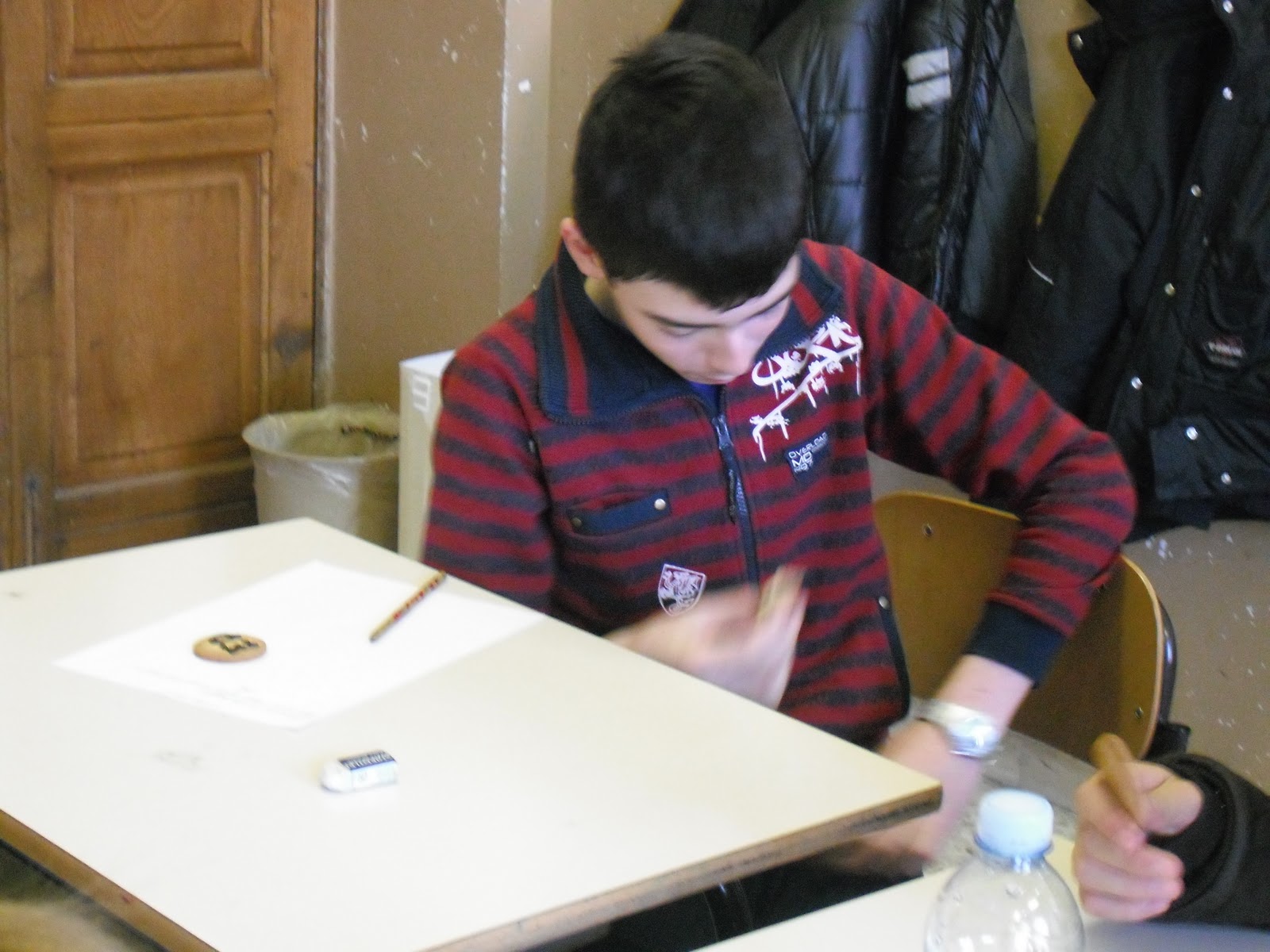


Next, pass to the bad news ( the irregular verbs with their forms to be studied by heart )
Homework for the following lesson : digest the Past Simple.
*******************************
I thought this could be an example of good practice......
Friday, December 9, 2011
The semi-flipped classroom: an experiment

What does "flipping the classroom" mean?
Basically it is a teaching method where students have to watch videos for homework while traditional home work is done in class with the teacher supervision.
What I did with my class
I wanted to give it a try. Keeping in mind that the best thing is always to take a "baby step" and start with a small change, this is what I did in a second class of Middle School.
We'd been dealing with present simple tense for some weeks and time had come to move on to the present continuous. The common procedure would have been:
P presentation
P practice
P production
P personalization
But this time we didn't start with the presentation phase.
In class I dictated some sentences in Italian ( their mother tongue ) to the students, who had previously divided a piece of paper into three sections, like this:

They wrote the sentences, in Italian, in the correct section, dividing them into now-actions, habits and past actions.
First thing after doing that, they ripped out the "past actions" part of their paper and they threw it away.
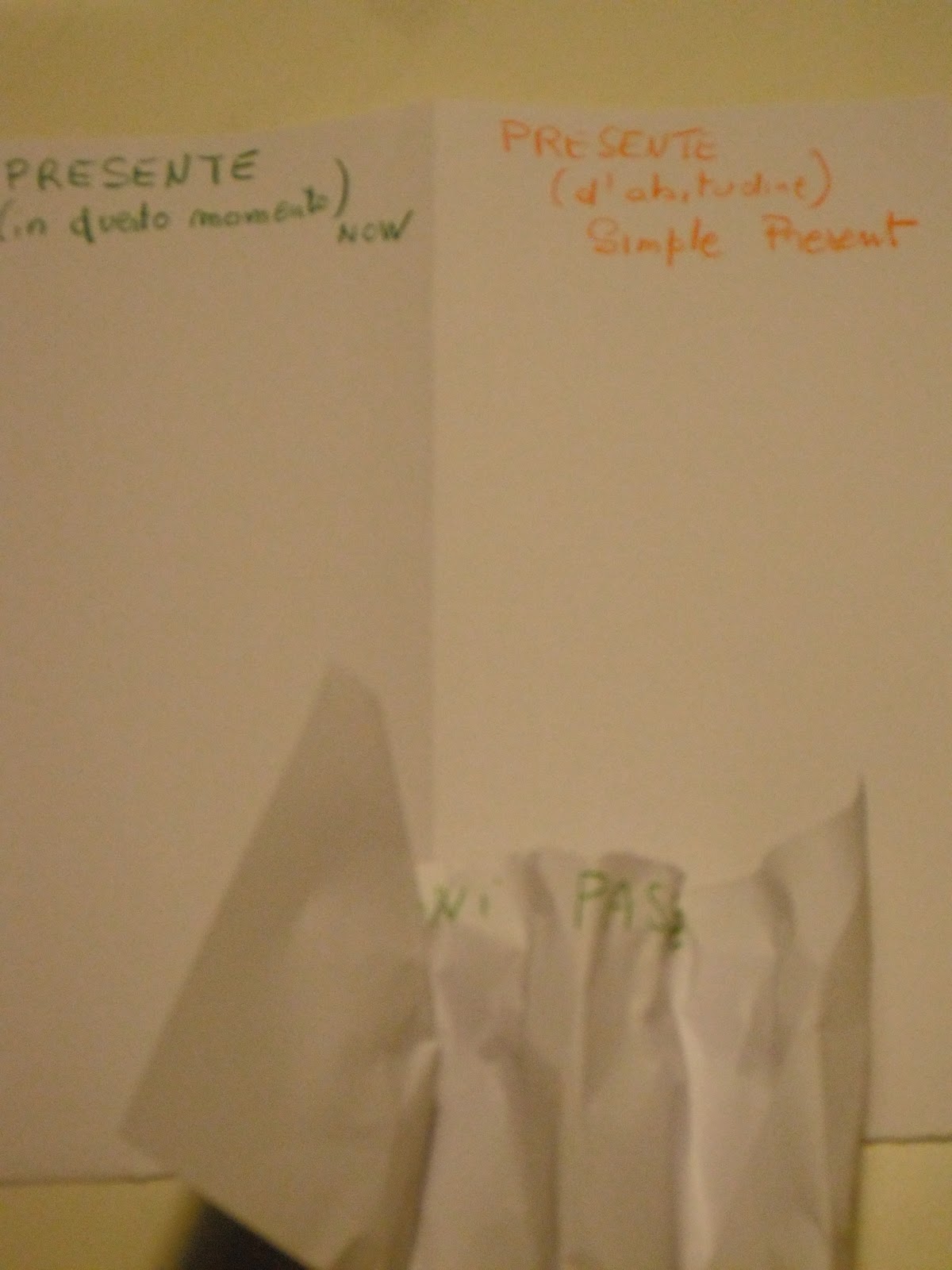
My intention was to make them physically aware of the fact we were dealing with present actions ( yes, maybe it's hard to believe and a bit disappointing, but some of them still had problems in fully grasping the concept of present/past actions ).
Then, as a class activity, we translated the "simple present" sentences into English and that was a revision of our last grammar topic. At this point they were left with some sentences they couldn't translate by applying what they knew. I told them they had to use a new grammar structure but I also declared I wasn't going to tell them anything about it, in other words: I wasn't going to "explain" it to them.
In short, this is what I said:
" Ok, let's see if you can do it by yourself. Go and watch this glogtster. There are some short videos explaining how to use the present continuous. Watch them carefully, as many times as you like, and, when you think you have figured it out, write the "rule" of this new tense on a piece of paper and put it in an envelope. Seal it, write your name on it and hand it in next lesson. I'm going to give you a "plus point" if you do it correctly."
NB
* "plus" and "minus" points are part of our classroom management, a sort of "token economy" approach. Students get plus and/or minus points, which are an integral part of their assessment.
* the envelope had the purpose to charge the activity with a sort of "formality", an official character, to make it appear important to the students' eyes.
I have to say that this task was optional, because not all the students have internet access at home. That's one of the reasons why I called it "the SEMI-flipped" class experiment.
This is the present continuous glogster I had previously done and published online.

The following lesson, 12 students out of 21 had done what I had asked them to do.
Nearly all of them had been able to understand how to form a sentence using the present continuous, as you can see from the pictures.
 |
 |
| Slideshow design made with Smilebox |
First reflections
I was obviously happy about the result especially because the 12 students were not just the best ones.
First thought was: " You see?! They don't even need a teacher..at least, not a teacher in the traditional way..."
and my second reflection was on how to "exploit" those savvy students for the whole class benefit.
So I gave my usual presentation on the topic to the class ( using IWB and Power Point and more ) and in the practice phase we worked in groups. In each group there was at least one present continuous-self-trained student. I got the impression that in the group work there was more energy and enthusiasm than there had been in other occasions.
A lot of practice lessons structured in this way gave them the opportunity to learn and consolidate the grammar point according to their learning styles. One of their final outcomes was the creation of a mindmap, where the main focus was on the two visual reminders ( the bee and the boeing ).

Click here to see another example of mindmap.
Results
Of course, at this point, I'm not able to draw conclusions on the students' ability to retain the information in the long-term memory, neither can I say this was the best way to introduce the topic, but I can share the results of the class test. Far from being the most effective way to assess students' learning, grammar tests are nevertheless quite clear indicators of the students' progression in the initial stages of Bloom taxonomy, that is they show how well a rule, a structure has been remembered and understood.
And the test results were amazing!
The class average test score was 8,4 out of ten, which is definitely high if we consider that middle school classes in Italy are strongly mixed-ability.
Conclusions
I called this experiment "the semi-flipped" classroom for two main reasons:
1) not the whole class watched the videos at home
2) the "explanation" phase was double and not only confined to something to be done at home, but it was used as a sort of reinforcement for some students and as check/verification for others.
It was certainly rewarding and I'd like to consider it a small step on a long path worth walking on.
This is a great infographic to visualize the concept of "flipped classroom"

Created by Knewton and Column Five Media
Wednesday, November 23, 2011

Monday, November 7, 2011

Subscribe to:
Posts (Atom)