A big thank you to Cristina ( III E ) and Martino ( III A ) who created e-flashcards and greatly contributed to the realisation of this Glogster. It may come in handy for those who are studying for KET exam.
Click here to open full size.
Showing posts with label vocabulary. Show all posts
Showing posts with label vocabulary. Show all posts
Sunday, March 11, 2012


Monday, January 23, 2012
INTEGRATING TECHNOLOGY: vocabulary expansion
What follows is a way to help students expand their vocabulary.
Especially at elementary level they tend to overuse the same basic words and their essays are quite repetitive.
Last week my class ( third year middle school ) was given a written test : " My trip to England", as a closing activity after a civilization unit about the United Kingdom.
While checking their essays I noticed their writings were full of words such as "go", "beautiful", "place" and "see".
I wanted to make them visually aware of this and so I asked them to recopy their texts using the computer, to save the file, to copy the document and to paste it into Wordle.
These are some of the word clouds they created.


 At school, the following lesson, the students examined each other's clouds and commented on them.
So we decided to work on the BIG words, the ones which recurred more often in their writings, and to find synonyms.
On the IWB we used a free visual Thesaurus .


Especially at elementary level they tend to overuse the same basic words and their essays are quite repetitive.
Last week my class ( third year middle school ) was given a written test : " My trip to England", as a closing activity after a civilization unit about the United Kingdom.
While checking their essays I noticed their writings were full of words such as "go", "beautiful", "place" and "see".
I wanted to make them visually aware of this and so I asked them to recopy their texts using the computer, to save the file, to copy the document and to paste it into Wordle.
These are some of the word clouds they created.


So we decided to work on the BIG words, the ones which recurred more often in their writings, and to find synonyms.
On the IWB we used a free visual Thesaurus .


We also used a great tool to work with collocations, Just the word.


The students updated their lexical notebooks with all the new nouns, verbs and adjectives.
I told them that, at this point, they had to take their essays and try to make them better,by adding and substituting words in the texts whenever possible.
One of them had a brilliant idea and proposed: " What if we do the same wordle thing again? After the redrafting, in the clouds there shouldn't be any big words. We should end up with a plain text!"
They liked the solution and, the following lesson, they were proud of their new wordle clouds.
Here are two of them.
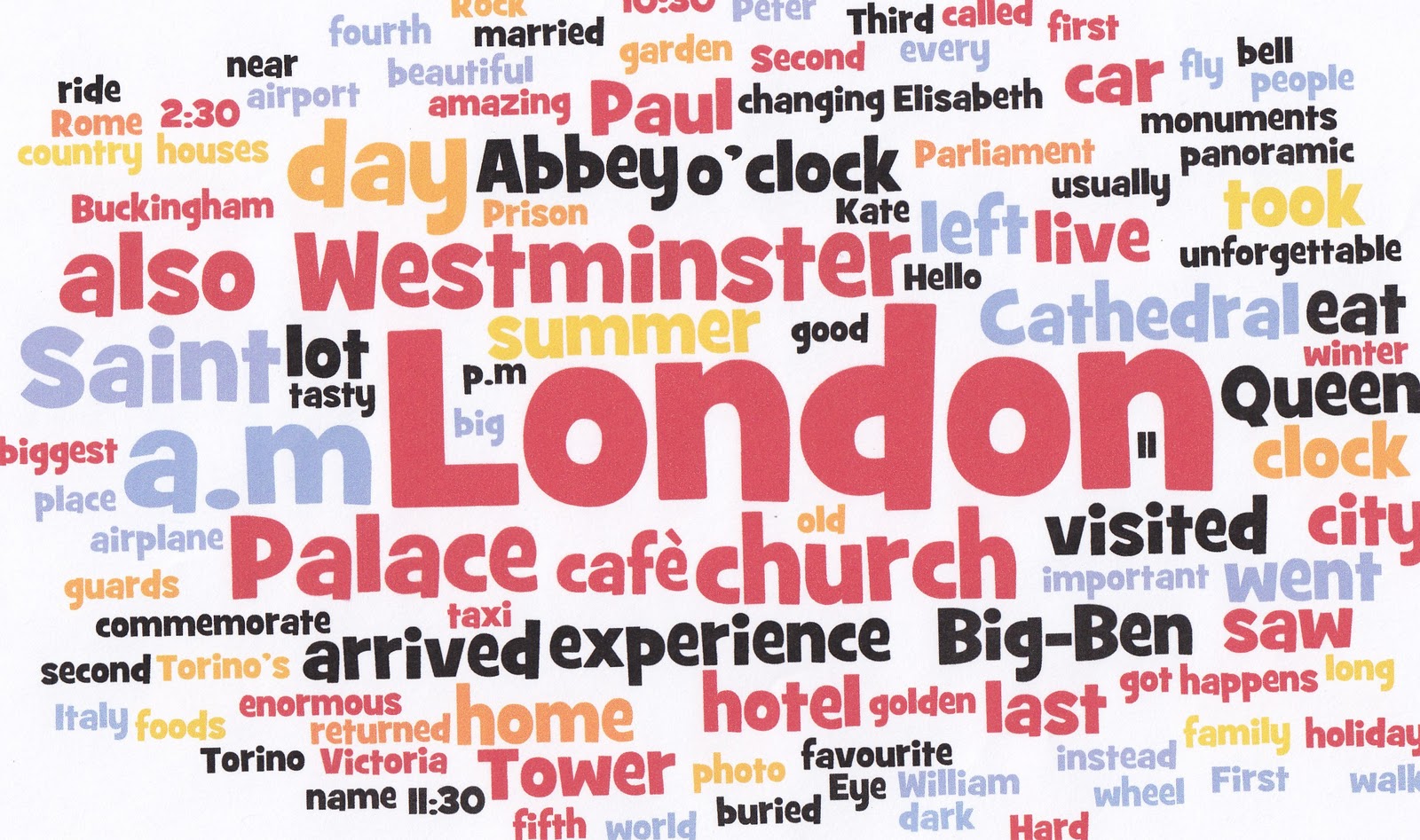
For more ideas on how to use Wordle in the classroom have a look at this presentation by David Dodgson.
You can also find interesting ideas here.
************************
PS What if I put this post into Wordle?

Whoops! Too many "words clouds" and "students"!
Wednesday, February 23, 2011
INTEGRATING TECHNOLOGY: "Strange Animals" class project
We've just finished a class project which involved 12-year-old Middle School students.
( II E from Istituto Comprensivo Villanova Mondovì. ).
Here is, step by step, how it developed.
"STRANGE ANIMALS"
Step 1: Eliciting already known vocabulary
Teaching aim: revising animals words
Web2 tools used : AnswerGarden, Wordle.
We started with an online poll . Students were asked to answer a very simple question: "What's your favourite animal?"
What's your favourite animal?... at AnswerGarden.ch.
Then we created a Wordle using their answers. That was the starting point for further work on vocabulary.

We also recycled common words introducing emoticons.
Students were shown smileys and had to guess the animals they represented.
Some new words were introduced using emoticons.
Here is a link to a site where you can find a lot of them
Others tried Bubblesnaps.
We thought we could let people comment on our creatures and we made a Voicethread.
Feel free to add comments if you wish.

Steps 6 : Wrapping things up
Teaching aims: making students reflect on the meaning of words such as "diversity", "imagination" and "creativity"
Web2 tools used: Animoto
A class discussion was led to fully understand the meaning of creativity and the incredible power of imagination. As a final consideration they came up with these simple words:
Close your eyes
Imagine
If you can think about it
It exists
In your mind
anything can live
Create your own video slideshow at animoto.com.
Create your own video slideshow at animoto.com.
Create your own video slideshow at animoto.com.
Monday, January 3, 2011
VOCABULARY PANEL - GLOGSTER
What does this picture remind you of?

It's the vocabulary panel which hangs on the wall of our classroom.
Time has come to digitalize it :).
Here you can find the Web2 version.
Click on the pockets and you can listen to the words and see the pictures.
You can find some games as well.
It's a work in progress...
You fill up the pockets with word cards and I keep on adding new links.
Click here to open the glogster.

It's the vocabulary panel which hangs on the wall of our classroom.
Time has come to digitalize it :).
Here you can find the Web2 version.
Click on the pockets and you can listen to the words and see the pictures.
You can find some games as well.
It's a work in progress...
You fill up the pockets with word cards and I keep on adding new links.
Click here to open the glogster.
Sunday, January 2, 2011
VOCABULARY CHALLENGE: 5 WAYS TO STORE WORDS

I love words.
When I read the post The Two Week Vocabulary Blogging Challenge I thought I could share some of the ways my students and I store words.
I have to confess I am a big fan of word cards, the small pieces of cards that have the foreign word on one side and its translation on the other, no matter if that is a picture, a definition or anything which can help the memorization process . If you are interested in vocabulary cards you may like to take a look at this article:
EMO-TIONAL Verb Cards - Ideas for Teaching Vocabulary

Maybe I am vocabulary-obsessed. I spend a lot of time teaching vocabulary, mnemonic techniques, introducing words, practicing, recycling and using them in different and personalized contexts. I am convinced that storing vocabulary items in a systematic way can greatly help students remember the words. When learners acquire new vocabulary they need concrete, physical ways to collect and keep it, a "safe" and personal place they can refer to whenever they want. At beginner level we organize vocabulary through topics.
We choose the way at the beginning of the first year of Middle School and then we stick to it for all the three-year course. The students regularly and systematically test themselves ( usually at the beginning of each lesson ) to check the learning of new items. Quick, whole-class activities are also provided to help vocabulary retention as well as autonomous tasks to carry out, using both technonology and traditional ways.
What follows are some ways of storing words which have been tested in class.
Vocabulary Notebook
Students use a "Vocabulary Notebook", which is a sort of self-created Pictionary, for systematic organization of vocabulary notes. This process involves abilities which are also extralinguistic, it is multiple-intelligence friendly and it works well with multi-level classes .
Here is an example ( created by a Middle School student , in year 1 and 2 )
Word Wheels

They're easy to build and students can keep track of all the words they should know: you need just some pins and templates. Again, they can write the translation or draw a picture in the empty spaces.

Slot Book
Each student has a folder divided into 12 separate slots where the vocabulary cards are kept. They start by inserting the words in slot number one, from where they go to number two and so on until the last slot. The final aim is making all the cards end up in the twelfth slot , meaning that those words should have been learnt. This method is for individual memory training and it is based on the memory principle of spaced repetition: in the last stage words can be revised less frequently.

Transparent Folders
These are folders with pockets to be inserted in ring binders which the students fill up with word cards . They come in handy when revising in pairs. The students face each other with the folder between them: one reads the mother tongue words while the partner has to provide the English forms and the other way round.

Vocabulary Panel
The storage systems described above are for individual reference and study.
As a class, we have a vocabulary panel on the wall. It is home-made :), it's got some pockets and students in turn prepare the cards to be put inside. A lot of activities are done systematically ( usually as a warm up at the beginning of the lesson ) in order to recycle and retrieve vocabulary.

And here is a Web2 version of the vocabulary panel. There are links to speaking dictionaries where the students can listen to the pronunciation of words and see the images. It' s a work in progress ans I'll keep on adding new links whenever I find some interesting sites.
WEB2 Vocabulary Panel


Wednesday, December 29, 2010
Tuesday, December 28, 2010
BASIC VERBS - GLOGSTER
Click here to open the glogster.
I've written the list of basic verbs we've been studying for some weeks ( year 1 ) and magicvocabulary has generated a lof of games and worksheets. The EMO-cards you can see on the glogster background were made by a very creative student, Eugenia, some years ago.
Ho inserito la lista dei verbi delle classi prime sul sito magicvocabulary , il quale ha generato attività e giochi interattivi utili per la memorizzazione.
I've written the list of basic verbs we've been studying for some weeks ( year 1 ) and magicvocabulary has generated a lof of games and worksheets. The EMO-cards you can see on the glogster background were made by a very creative student, Eugenia, some years ago.
Ho inserito la lista dei verbi delle classi prime sul sito magicvocabulary , il quale ha generato attività e giochi interattivi utili per la memorizzazione.

Sunday, December 19, 2010
Subscribe to:
Posts (Atom)